

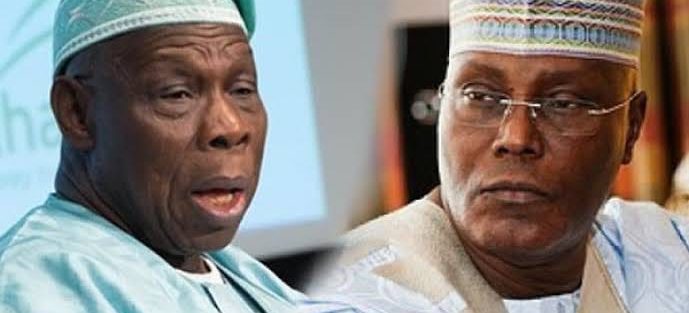
Former Vice President Atiku Abubakar has strongly responded to former President Olusegun Obasanjo’s statement that choosing him as vice president in 1999 remains his greatest political regret, insisting that he stood firmly by the former leader during one of the most difficult periods of his life.
In a statement issued on Saturday through his Senior Special Assistant on Public Communication, Phrank Shaibu, Atiku said he was saddened rather than angered by Obasanjo’s comments, expressing confidence that history would ultimately judge the relationship between them fairly.
According to Atiku, he and other patriotic Nigerians played significant roles in supporting Obasanjo’s family during his imprisonment and in working towards his eventual release.
Recalling the period following Obasanjo’s release from prison, Atiku said the former president had little to his name and that he personally ensured he received the support needed to rebuild his life.
“When he eventually regained his freedom, he had little to his name. I received him, clothed him, ensured he was properly cared for, and extended every support necessary to help him regain his footing,” Atiku stated.
The response follows remarks made by former President Obasanjo during the unveiling of activist Charly Boy’s foundation and memoir in Lagos on Friday. Obasanjo described his decision to select Atiku as his running mate in the 1999 presidential election as the greatest political regret of his career.
According to Obasanjo, what he later discovered about Atiku convinced him that he would never have chosen him as vice president. However, he acknowledged that despite their differences, Atiku did not derail his administration or cause harm to Nigeria, adding that he held no personal grudge against his former deputy.
The once-close political alliance between the two leaders deteriorated during Obasanjo’s second term in office, resulting in years of public accusations and political disagreements over issues including corruption, abuse of office, and betrayal.
Responding to the renewed criticism, Atiku attributed Obasanjo’s resentment to his refusal to support the controversial third-term agenda, insisting he remains proud of his role in defending Nigeria’s Constitution and democratic principles.
“If Chief Obasanjo’s resentment stems from my refusal to support the third-term agenda, then I wear that as a badge of honour. No individual is greater than the Constitution,” Atiku said.
He maintained that opposition to the proposed constitutional amendment was a collective effort by patriotic Nigerians determined to safeguard democracy and argued that history had vindicated those who resisted the move.
Atiku also referred to recent comments reportedly made by Ngozi Okonjo-Iweala, who praised the economic management team that served during the Obasanjo administration as one of Nigeria’s strongest.
While emphasizing that he had no regrets about supporting Obasanjo after his release from prison, Atiku expressed disappointment that past political disagreements were resurfacing at a time when Nigeria faces pressing economic challenges, unemployment, and insecurity.
He concluded by saying that although he had exercised restraint over the years out of respect for Obasanjo’s former office, history could not be rewritten through bitterness or repeated falsehoods, adding that Nigerians and history would ultimately render the final judgment.