
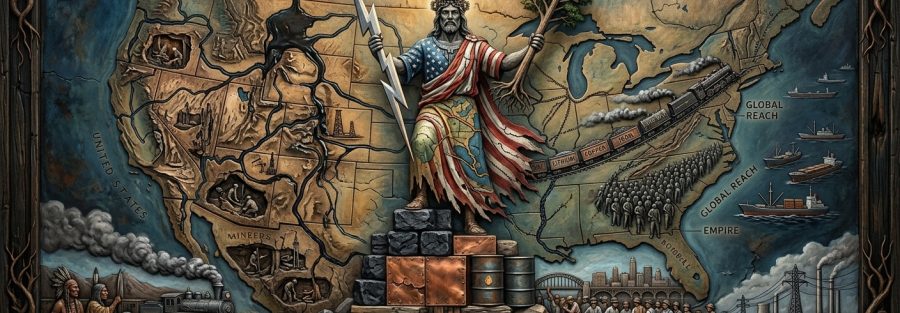
Empires rarely introduce themselves honestly.
They arrive wearing poetry.
The Romans spoke of civilization. The British spoke of trade and enlightenment. And the modern superpower, the United States, speaks the language of salvation.
Not religion exactly, though the structure feels familiar. A troubled land appears somewhere on the world stage. A villain rises. Democracy trembles. Innocent civilians are said to be in danger. Then, almost on cue, the cavalry arrives from across the ocean; aircraft carriers, coalition statements, humanitarian language, and a narrative that has been repeated so often that many countries have learned to whisper it to themselves before anyone else does.
America will save us.
It is one of the most powerful geopolitical stories ever told. And like most powerful stories, it contains elements of truth, layers of exaggeration, and beneath it all something quieter and far less romantic, interests that rarely make it into the press conference.
Modern civilization runs on energy. Oil, natural gas, coal, electricity; the invisible arteries of the global economy. Every factory, airplane, shipping lane, and data center is plugged into this network of energy flows. The countries that secure energy supply lines secure industrial power. The countries that secure industrial power shape geopolitics.
The United States contains roughly four percent of the world’s population, yet it consumes about sixteen percent of global energy. In the early 2000s that number approached a quarter of the planet’s total consumption. Suburbs stretching across thousands of miles, highways thick with vehicles, a military apparatus spanning continents, and an economy built on constant motion require enormous fuel. If those flows stop, the system trembles. Energy security therefore became not just an economic priority for Washington but a strategic doctrine.
If one studies a map of the world’s largest oil reserves, a curious pattern begins to emerge. Saudi Arabia holds about 267 billion barrels. Iran about 157 billion. Iraq around 145 billion. Russia more than 100 billion. The United Arab Emirates nearly 100 billion. Libya roughly 48 billion. Nigeria about 37 billion. Many of these regions have experienced American military presence, strategic alliances, or direct intervention at various moments over the past several decades. Coincidence is possible, of course. But geopolitics tends to follow patterns more than coincidence.
The architecture of this system took shape during a crisis in 1973. That year the Middle East erupted into conflict in what history remembers as the Yom Kippur War. Egypt and Syria attacked Israel. The United States supported Israel. In response, Arab oil producers led by OPEC imposed an oil embargo against Western nations. The result was immediate and terrifying for industrial economies. Oil prices quadrupled almost overnight. Fuel shortages appeared across Europe and the United States. Gas stations closed. Lines stretched for miles down American streets.
For the first time since the industrial revolution began, Washington confronted a stark reality: the world’s largest economy depended on energy controlled elsewhere. A strategic solution was needed. That solution arrived quietly through a partnership with Saudi Arabia. Saudi Arabia agreed to sell its oil exclusively in U.S. dollars. In return the United States provided military protection and security guarantees. Other oil producers followed the same model, and the petrodollar system was born. Oil, the most important commodity in the global economy, would be priced largely in dollars. Every country that needed energy would therefore need American currency.
The implications were enormous. Global demand for dollars surged. The U.S. currency became the dominant reserve currency held by central banks around the world. Energy and finance fused into a self-reinforcing system: oil flowed outward from producing countries, and dollars flowed back toward the United States through global markets. This arrangement strengthened American economic influence and helped finance an enormous global military network.
But systems like this rarely remain uncontested forever.
In the early 2000s Iraqi leader Saddam Hussein announced plans to sell Iraqi oil in euros instead of dollars. Three years later the United States invaded Iraq under the administration of George W. Bush. The justification presented to the world was that Iraq possessed dangerous weapons of mass destruction and posed a threat to international security. Those weapons were never found. What Iraq undeniably possessed, however, was one of the largest oil reserves on Earth, roughly 145 billion barrels.
The war lasted years and reshaped the Middle East. More than 4,400 American soldiers died. Civilian casualties in Iraq are estimated in the hundreds of thousands. The financial cost to the United States climbed above two trillion dollars. Yet once the war subsided, Iraq’s oil sector reopened to international energy companies and production climbed again toward four million barrels per day, restoring the country as a major supplier in global markets.
A similar narrative appeared in Libya nearly a decade later. In 2011, under Barack Obama, NATO intervened in Libya during an uprising against long-time leader Muammar Gaddafi. The intervention was framed as a humanitarian mission designed to protect civilians in the city of Benghazi. Libya surprisingly happened to hold the largest oil reserves in Africa, about 48 billion barrels. After the NATO campaign, Gaddafi was killed and the Libyan state fragmented into rival factions and militias. Yet oil production eventually resumed because global markets depend heavily on Libyan crude.
Not every strategic energy relationship arrives with bombs and missiles. Some are quieter. Nigeria, Africa’s most populous country, sits atop about 37 billion barrels of oil and produces roughly 1.3 to 1.5 million barrels per day. Its offshore fields in the Gulf of Guinea form an important component of global crude supply. For decades the region has drawn Western attention not only because of its oil, but because of its position along key Atlantic shipping routes.
Yet Nigeria’s importance to global strategy may be evolving beyond oil. Geological surveys in parts of the country have identified deposits of rare earth minerals; a family of elements essential for modern technologies such as electric vehicles, smartphones, advanced batteries, wind turbines, and military electronics. At present, the overwhelming majority of the world’s rare earth processing capacity is concentrated in China, which has spent decades building dominance in this critical supply chain. China controls a large share of global rare earth production and an even larger share of refining and processing.
For Washington, this dependence has become a strategic vulnerability. Rare earth minerals are vital for everything from fighter jet guidance systems to renewable energy infrastructure. Reducing reliance on Chinese supply therefore became a growing priority in American industrial policy and national security planning.
Countries with emerging rare earth potential suddenly gained new strategic significance, and Nigeria sits among those being studied more closely by Western investors and policymakers. A foothold in Nigeria’s mineral sector; if commercially viable deposits are developed could contribute to diversifying supply chains away from China.
In this context, geopolitical narratives can sometimes intersect with domestic tensions in complicated ways. Nigeria has long experienced conflicts framed through religious or communal lenses, particularly between communities identified as Christian and Muslim. International advocacy groups, media outlets, and foreign policymakers often interpret these conflicts through the language of religious persecution or ideological struggle. While such interpretations sometimes highlight genuine humanitarian concerns, critics argue that geopolitical competition can quietly shape how global powers engage with these narratives.
For the United States, strengthening strategic relationships in Nigeria could simultaneously serve multiple objectives: securing energy partnerships, maintaining influence in the Gulf of Guinea, and potentially gaining future access to rare earth resources that might reduce dependence on Chinese supply chains. In the wider strategic competition between Washington and Beijing, even mineral deposits buried beneath remote landscapes can acquire global importance.
Far west across the Atlantic, another energy struggle has unfolded in Latin America. Venezuela holds the largest proven oil reserves in the world, even larger than those of Saudi Arabia. For years its government under Nicolás Maduro pursued closer economic ties with China and other non-Western partners. Venezuelan oil exports increasingly flowed toward Asian markets, and discussions around trading oil outside the traditional dollar system occasionally surfaced, including the use of China’s currency, the yuan.
Washington responded with years of sanctions, indictments, and diplomatic pressure. In 2020 the United States formally charged Maduro with narcoterrorism and offered a reward for information leading to his arrest. By 2025 the bounty had risen to $50 million, the largest reward ever offered by the United States for a foreign head of state.
The confrontation escalated dramatically in early 2026. A U.S. military-supported operation captured Maduro and transferred him to the United States to face federal charges. Venezuelan authorities described the event as a kidnapping, while Washington framed it as a law-enforcement action against an indicted criminal leader. The operation resulted in dozens of casualties among Venezuelan and allied security personnel during the raid.
The geopolitical implications were immediate. Oil markets reacted sharply, and analysts began reassessing global energy flows and alliances following the capture. China, Venezuela’s largest oil buyer and financial backer, strongly condemned the operation, describing it as a violation of sovereignty and warning it could destabilize regional politics.
Farther east lies one of the most critical choke-points in the entire global energy system. The Strait of Hormuz is only about thirty-three kilometers wide at its narrowest point, yet nearly one fifth of the world’s oil supply passes through it each day. Nearby sits Iran, a nation holding around 157 billion barrels of oil and vast natural gas reserves.Every tanker leaving Saudi Arabia, Kuwait, Iraq, Qatar, and the UAE must pass through it. The global economy quite literally squeezes through this corridor.
Control Hormuz, and you control the valve of the modern world.
Iran sits beside it.
This alone explains why Iran has been the subject of relentless geopolitical pressure for decades. Sanctions. Proxy conflicts. Nuclear negotiations. Military threats. Any disruption in the strait could send global energy markets into immediate crisis. It is therefore unsurprising that the United States Navy maintains a powerful presence in the Persian Gulf. Protecting shipping lanes is not simply regional politics; it is insurance for the entire global economy.
In April 2026, Donald Trump publicly threatened Iran with annihilation if it did not comply with American demands surrounding the reopening of the Strait of Hormuz. He warned that “a whole civilization will die tonight” if Iran ignored his deadline.
The language was not subtle.
It was not diplomatic.
It was naked!
The message was clear: open the artery of oil or face destruction.
Within hours, the threat sent shockwaves through global markets and diplomatic circles. Eventually, Trump paused the planned strikes after negotiations produced a temporary ceasefire tied to reopening shipping lanes.
But the threat itself revealed the deeper truth.
When American presidents speak about Iran, they rarely speak about oil.
They speak about nuclear weapons.
They speak about terrorism.
They speak about freedom.
Yet the strategic map tells a simpler story.
Iran is not just another Middle Eastern state. It is a gatekeeper of global energy circulation.
Energy again appeared at the center of geopolitics when Russia invaded Ukraine in 2022. Before the war, Europe depended on Russia for roughly forty percent of its natural gas supply. Sanctions against Russian energy triggered a dramatic reconfiguration of global markets, increasing demand for alternative suppliers including liquefied natural gas exports from the United States. Meanwhile the contested peninsula of Crimea, annexed by Russia in 2014, sits near significant offshore gas reserves in the Black Sea, strengthening Moscow’s control over regional energy resources.
Maintaining influence over these global energy arteries requires enormous infrastructure. The United States spends more than eight hundred billion dollars annually on defense and maintains military bases in more than seventy countries. Major defense contractors such as Lockheed Martin, Raytheon Technologies, and Northrop Grumman receive large government contracts to produce aircraft, missile systems, and surveillance technology. Meanwhile energy companies benefit when geopolitical tensions push oil prices higher. War may be expensive for governments, but it can be profitable for certain industries.
Military strength alone, however, cannot sustain global legitimacy. Stories are required, narratives that transform strategy into moral purpose. For decades the United States Department of Defense has collaborated with Hollywood productions. Films such as Top Gun and Black Hawk Down received access to military equipment, aircraft carriers, and training facilities. In exchange scripts are often reviewed before cooperation is granted. Over eight hundred films and television projects have involved Pentagon assistance, producing decades of cinematic storytelling in which American soldiers appear as heroic guardians of freedom.
While the true depth of this influence is often obscured, estimates suggest that billions of dollars are funneled annually into the broader infrastructure of narrative control. This is not just a budget; it is a global subscription fee for a reality you did not realize you had signed up for. The U.S. Agency for Global Media (USAGM) broadcasts “liberty” in forty languages, while the Department of Defense (DoD) operates specialized Entertainment Liaison Offices for each military branch. These offices have assisted in over 2,500 war-themed movies and TV programs since the dawn of the industry, trading access to billion-dollar warships for the right to edit the American story.
The true brilliance, however, is not the spending; it is the casting. Each president is simply a new lead actor brought in to freshen up a long-running franchise that refuses to be canceled, ensuring the “Saviour” brand remains intact while the real agenda: dominance and resource acquisition, remains buried in the fine print.
In the real world, the invasion of Iraq killed between 100,000 and 500,000 Iraqis, yet movies like American Sniper (2014) focus on the heroism of the sniper as a protector.
Because “We need to control the flow of natural gas and secure trade routes” does not test well with audiences.
But “We are here to save the world” gets a standing ovation every time.
History does not remember what happened; it remembers the version that was told with the biggest marketing budget.
America does not just fight; it produces. It does not just intervene; it casts itself as the only possible protagonist in a world it spent billions of dollars convincing us was falling
“But, Baron, you’re just over thinking it, with your constant pessimistic mindset, America is the good guy”
Well, none of this means that every American intervention is motivated solely by oil or minerals, nor does it mean ideals play no role in foreign policy. Nations rarely act from a single motive. Ideology, alliances, security concerns, and humanitarian pressures all shape decisions.
But energy and strategic resources remain among the most consistent forces guiding global power.
And so the saviour narrative persists.
A crisis erupts somewhere in the world. Cameras turn toward the conflict. Politicians deliver urgent speeches. Headlines describe the defense of democracy and the protection of civilians. And across the ocean, an aircraft carrier quietly adjusts its course.
Perhaps the mission truly does protect innocent lives. Perhaps it stabilizes a fragile region.
What do I know?
But somewhere behind the speeches and headlines, there is often another map, one showing pipelines, mineral deposits, shipping routes, and narrow waterways through which the lifeblood of the modern world continues to flow.
Because behind every empire’s moral story, there is usually something far more practical.
Energy. Minerals. Supply chains.
And whoever keeps those moving, keeps the modern world and their power within it alive.
Baron Harry