

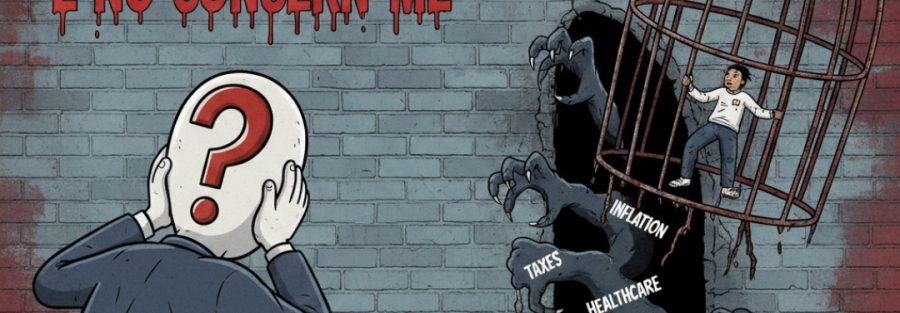
E No Concern Me: Why Ignoring Politics Costs You
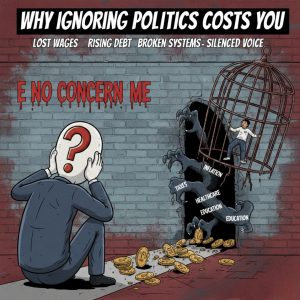
As a strong political commentator, a person who can turn a casual hangout into a constitutional summit without touching a microphone, one feedback trails me like background music. “Baron, you love politics too much. Carry this your debate somewhere else. Let us talk about something light.”
And when I stretch the conversation beyond our borders, when I mention wars in Europe or tensions in Asia, I hear it again: “Why are you worrying about other countries? Face Nigeria.”
Then comes the final line, the one people think settles everything: “No matter how you talk about it, nothing will change.”
It sounds calm. It sounds grounded. It sounds like someone has accepted the limits of individual power. But let’s be honest: it’s comforting nonsense. A lie we tell ourselves to avoid thinking too hard, to avoid the headache of acknowledging that our lives are entangled in things we cannot see. Yes, I may not stop wars. Yes, my commentary may not rewrite national budgets. Yes, one citizen cannot single-handedly redirect global capital flows. But awareness is not about controlling the storm. Awareness is about not being swept away by it. And in this country, in this city, in this life we live, not being swept away is power.
When Russia invaded Ukraine, missiles flew thousands of miles away, but the shockwave landed in Nigerian markets. Wheat exports tightened. Fertilizer prices surged. Oil markets reacted violently. Bread prices climbed. Animal feed costs rose. Poultry prices followed. Transport costs spiked. The naira trembled. Households adjusted. Mothers whispered about how the price of yam would stretch just a little less this month. Fathers calculated how much fuel they could afford before their wallets screamed.
A war in Eastern Europe did not stay there. It restructured household budgets in Lagos, Kano, and beyond.
When tensions flare between Israel and Gaza, the logic is the same. Oil markets price in uncertainty instantly. Nigeria, whose fiscal planning depends heavily on oil revenue, becomes vulnerable. Revenue projections wobble. Public spending calculations twist and turn. Investors rethink. Geopolitical instability abroad becomes economic instability at home.
When rivalry intensifies between China and Taiwan, semiconductor supply chains tremble. Taiwan dominates advanced semiconductor manufacturing. Semiconductors power smartphones, medical equipment, point-of-sale terminals, communication networks, industrial machinery. Nigeria imports nearly all of this. A disruption anywhere in that supply chain hits our economy like a power cut during a Lagos rainstorm. Device prices spike. Telecom expansion slows. Medical equipment becomes more expensive. The digital economy, which many pin their hopes on, becomes vulnerable. A superpower spat in East Asia can quietly alter startup costs in Yaba.
Closer to home, coups in Niger and Burkina Faso are not distant dramas for diplomats. They destabilize the fragile Sahel belt bordering Northern Nigeria. Arms circulate. Extremist groups regroup. Borders become porous. Security risks rise. Agricultural production drops. Food supply chains tighten. Government spending pivots toward defense, often at the expense of education and health.
Even policies abroad, like the Trump-era trade wars or US monetary tightening, ripple here. The dollar rises. Nigeria’s dollar-denominated debt gets heavier. Imports cost more. Inflation intensifies. When the global financial center tilts, the naira reacts. Nigeria is already entangled. It is plugged into commodity markets, capital flows, global supply chains. You cannot “face Nigeria” without acknowledging the forces acting from continents away.
Here is the uncomfortable layer. Global shocks are inevitable. Domestic policy choices are deliberate. Sometimes Nigeria magnifies the impact of external turbulence through its own structural decisions. Exporting crude oil while importing refined fuel exposed us to double volatility. When global oil prices rise, subsidy obligations expand. When subsidies are removed abruptly, transport costs surge overnight. Market prices adjust upward within weeks. Wages lag. Real income collapses. Years of multiple exchange rate windows created artificial calm. When corrections finally came, the naira depreciated sharply. Businesses dependent on imported inputs faced soaring costs. Some shut down. Others downsized. Households absorbed inflation layered upon inflation.
Border closures meant to protect domestic agriculture disrupted supply chains, raised prices, and expanded smuggling networks. Security expenditure continues to rise due to persistent instability, competing with health and education funding. External shock plus internal fragility equals amplified crisis.
Geopolitics exposes structural weaknesses. Domestic policy determines whether those weaknesses collapse the system.
And then there is that familiar sentence: “Nothing will change.” Maybe not immediately. Maybe not because I speak. But change is inevitable. Oil prices fluctuate. Interest rates rise and fall. Exchange rates adjust. Commodity cycles rotate. Capital flows move.
The real question is not whether change happens; it always does. The question is whether you are prepared for it. Understanding geopolitics is not just civic engagement. It is survival.
Awareness allows you to anticipate rising food and energy prices when conflict erupts in Eastern Europe. It allows you to prepare for currency pressure when US monetary tightening strengthens the dollar. It allows you to foresee technology price spikes when East Asian supply chains face disruption.
You may not control the global stock market. But by watching policy direction, central bank behavior, and geopolitical alignment, you can anticipate whether markets are leaning toward risk or caution. You can know what to stockpile and what to discard. You can identify sectors vulnerable to policy shifts. You can anticipate inflation before it fully manifests. You can reduce exposure to currency shocks. That degree of awareness insulates you from the cost of ignorance.
Politics is not noise. It is architecture. It designs the environment within which your income exists. It shapes the value of your savings. It influences the cost of your essentials. It determines whether shocks are absorbed or amplified.
Resignation is not strategy. You may not command the system, but you can understand it. You can anticipate it. You can position yourself within it. In volatile economies, the difference between the informed and the uninformed is not small. It is stability. It is opportunity. It is resilience. It is survival.
And yet there is a human dimension we cannot ignore. I have watched families quietly recalibrate when the price of bread jumps overnight. I have seen students delay tuition payments because currency fluctuations made previously affordable fees suddenly unattainable. I have met small business owners who, by noticing the signals;oil price trends, shipping delays, currency moves; avoided bankruptcy while others shuttered. Awareness translates into action, and action translates into resilience.
You may not rewrite the global political map, but you can navigate it with foresight. You can allocate resources with prudence. You can protect the fragile equilibrium of your household before external shocks arrive. The illusion that nothing will change is comforting. It allows us to avoid thinking too hard. But that illusion is expensive. Every day, every market fluctuation, every political headline carries consequences for those who remain unaware.
That is why politics is personal. Because the architecture it designs is the architecture within which your life unfolds.
So yes, I speak of Ukraine, Gaza, Taiwan, the US, Niger, Burkina Faso, not because I believe one essay or one conversation can rewrite these events, but because the consequences land in Lagos, Kano, and Abuja regardless. Nothing will change in the abstract, but being unaware guarantees that you will bear the cost unprepared.
Understanding changes how you interact with the economy, how you plan your life, how you absorb shocks, how you seize fleeting opportunities. It does not make you omnipotent. It makes you competent. It makes you informed. It gives you agency where agency is often assumed absent.
The conversation may feel heavy, even exhausting, even relentless. But in a world governed by geopolitics and policy, awareness is insulation. And insulation, especially in turbulent times, is power. Informed observation is the closest thing to control we possess, and it is a shield that protects what matters most — the life you live, the resources you steward, the family you provide for. That is why I cannot stop talking about it. That is why you cannot stop me from analyzing it. Because the storm is real. And those who understand its patterns rarely get caught flat-footed.